
Important notice before reading this post
Nothing in this article is intended to be legal advice; all information is for educational purposes only.
This article has been reviewed by a certified immigration lawyer.
What is the J1 Trainee visa, and who is it for?
The J-1 Trainee is one of the 15 J-1 visa exchange programs.
The J-1 Trainee program is designed for professionals seeking to develop their skills and gain professional experience in the United States through structured training with a U.S. host company. It is open to professionals at all levels, from early-career roles to experienced specialists and managers. The J-1 Trainee Program has no maximum age limit and no salary cap.
If you are a student or recent graduate, check the J-1 Intern program instead.
For example, Maxime had more than eight years of experience as a software engineer when he participated in the J-1 Trainee Program. He received compensation comparable to that of other employees within the company. As his spouse, I obtained a J-2 visa, which allowed me to live in the United States and apply for work authorization.

The criteria of eligibility for obtaining a J1 Trainee visa
Requirements for Participants
To be eligible for this visa, you must have:
- a degree in higher education or an equivalent certificate obtained in an institution outside of the United States,
- at least one year of experience outside the U.S. territory in the sector of activity you want to pursue (note that if you do not have any professional experience but have a degree, you may be eligible for a J-1 intern visa, limited to 12 months).
OR
- 5 years of experience (starting at the legal age) outside the U.S. territory in the sector of activity that you wish to strengthen.
If you are a student or have graduated within the past 1 year, you may qualify for the J-1 Intern visa instead.
Eligible Occupational Categories & Training Plan
The eligible sectors for obtaining a J1 Trainee visa are:
- Agriculture, Forestry, and Fishing;
- Arts and Culture;
- Construction and Building Trades;
- Education, Social Sciences, Library Science, Counseling and Social Services;
- Health Related Occupations;
- Hospitality and Tourism;
- Information Media and Communications;
- Management, Business, Commerce, and Finance;
- Public Administration and Law; and
- The Sciences, Engineering, Architecture, Mathematics, and Industrial Occupations.
The J-1 Trainee visa is not suitable for roles involving childcare, eldercare, or any patient interaction. If you are pursuing opportunities in these areas, you might qualify for alternative visas or specific J-1 programs, such as the J-1 Physician.
See more information about the eligibility regarding the training and the host company.
Length of Stay
J1 Trainee Visa Duration
The visa is valid for up to 18 months, except in the Hospitality and Tourism category, where the maximum program duration is 12 months. Participants may enter the United States up to 30 days before the program start date and remain for up to 30 days after the program end date for tourism purposes. As a result, the total stay in the U.S. can be up to 20 months, or up to 14 months for Hospitality and Tourism programs. The minimum program duration is 3 weeks.
J1 Extension
You can extend your J-1 visa up to its maximum duration mentioned above.
Repeat Participation
You can participate in multiple J-1 Trainee programs in the United States as long as you remain eligible (see eligibility requirements). You may repeat a J-1 Trainee program after spending at least 24 months outside the United States.
If you progressed to a higher degree (by enrolling in a higher-level program), you may qualify for a J-1 Intern program with no wait time because you are again a full-time student.
Can I Get Another U.S. Visa After a J-1 Visa?
The J-1 visa is designed for temporary cultural exchange and is not intended for immigration purposes.
That being said, participating in a J-1 program does not negatively impact your ability to apply for other U.S. visas in the future, whether from abroad or, in some cases, from within the United States.
However, certain participants may be subject to the two-year home residency requirement, which requires them to return to their home country for 2 years before becoming eligible for certain visas or immigration pathways.
Change of Employer During Your J1 Program
In certain cases, you may switch to another employer with sponsor approval. This is generally allowed if the current employer is unable to provide the training outlined in your approved program plan.
However, switching solely for a higher salary is not a valid reason, as the J-1 visa is designed for professional and cultural exchange, not for employment for financial gain.
Compensation and Health Coverage
Role & Compensation
The J-1 visa is not intended for regular employment, but you may work as long as the primary purpose of your role is outlined in a formal corporate training plan (DS-7002). This plan must demonstrate that the position is focused on structured learning and professional development rather than filling a job vacancy.
There are no strict minimum or maximum salary requirements under the program. However, if you are unpaid or earn less than $1,500 per month, you may be required to demonstrate sufficient personal financial resources at the time of your application. Extremely high salaries are not prohibited if the training structure remains valid.
In our example, under the J-1 visa, Maxime earned the same salary as other employees at his company who were working at the same level and in the same field.
Health Insurance Coverage
The health insurance provided by the sponsor is mandatory and usually very competitive with standard U.S. health insurance costs ($99 per month, compared to an average of around $500 per month for an individual). This insurance helps cover your medical expenses, which can be extremely high in the United States.
Tax Benefits
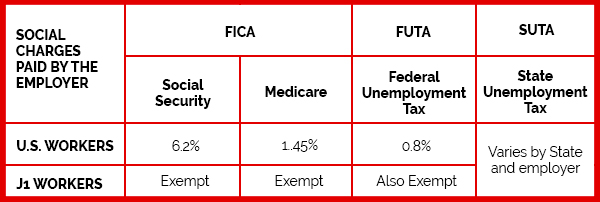
Because the J-1 is an exchange visitor visa, not an immigration-based employment visa, you and your employer may benefit from certain tax advantages under the J-1 visa. J-1 participants are exempt from:
- Social Security Tax
- Medicare Tax
- Federal and State Unemployment Taxes
As a result, both the employer and the participant may experience reduced payroll tax obligations. These savings are often estimated at approximately 7.65% for each party, depending on the specific circumstances and eligibility. Below is a table summarizing the potential J-1 tax benefits:
Can I Bring My Family?
Yes! All your dependents (spouse and/or children under 21 years old) may apply for a J-2 visa, which allows them to live in the United States with you. You will need to demonstrate that you can cover your family’s living expenses through your salary and/or personal financial resources.
Only legally married spouses are recognized for this purpose; cohabitation or civil unions are not accepted under U.S. immigration rules.
Your spouse may also apply for work authorization, which allows them to work in the United States. Your children may be enrolled in school.
All dependents are typically covered under the sponsor’s health insurance plan. Please contact us for more information regarding the J-2 application process and associated fees.
Application Process
J-1 Visa Application
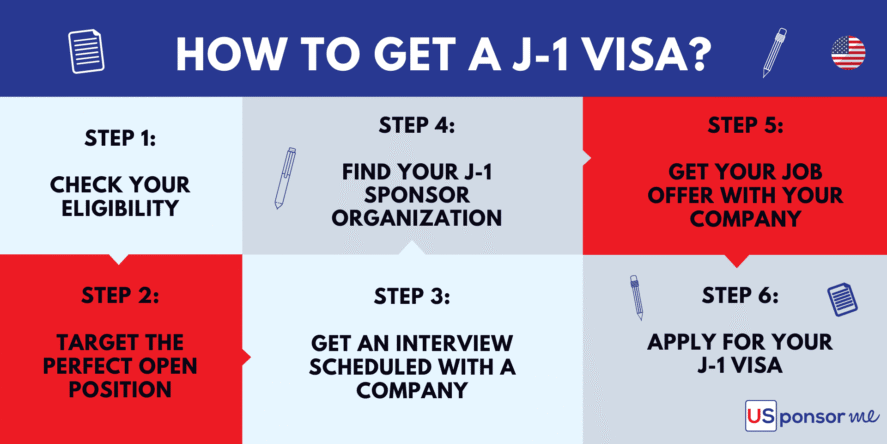
Unlike some other visa categories, the J-1 visa is not sponsored by your host company but by a designated J-1 sponsor organization. You cannot complete your visa application without an approved J-1 sponsor.
There are four key parties involved in obtaining a J-1 visa:
- Yourself
- Your host company (where you will complete your training)
- Your J-1 agency, working in partnership with a designated J-1 sponsor organization (which issues your DS-7002 and DS-2019 forms and guides you through the visa process and beyond)
- The U.S. embassy or consulate (which issues your J-1 visa)
These parties cannot move forward with the visa process until you have secured a training opportunity. Once you receive an offer from a host company, you can begin your J-1 visa application.
You do not need an immigration lawyer to get the J-1 visa. As a J-1 agency, we support you throughout the entire process, in coordination with an official J-1 sponsor. See our visa application process in detail.
Unlike some other visa categories, there is no annual quota for J-1 visas, and applications can generally be submitted at any time during the year.
J-1 Visa Processing Time
The processing time for a J-1 Trainee visa typically ranges from 3 to 12 weeks, depending on the chosen sponsor organization, whether expedited processing is paid for, and the consulate’s availability for an interview.
With us, it takes up to 15 business days to get your DS2019.
J-1 Cost
J-1 Fees
A visa is never free.
The cost of obtaining a J-1 visa depends on the J-1 agency you choose. Costs range between $3,000 and $5,500 for the maximum duration. Check the details of our J1 fees.
Who Will Pay Your J-1 Visa Fees?
The cost of a J-1 visa may be covered either by you or by your host employer. As the J-1 program is primarily designed as a training and cultural exchange experience to enhance the participant’s skills, the cost is most often borne by the candidate. However, some host companies may choose to contribute to or fully cover these expenses.
It is therefore important to factor in visa costs when planning your overall relocation budget to avoid any financial shortfalls.
Apply for a J-1 Visa
Once you receive an offer from a host company, you’re ready to start your J-1 visa application. As a J-1 agency, we guide you every step of the way, in close coordination with an official J-1 sponsor.
Get started now by completing our assessment form. Our team will quickly review your eligibility and get back to you with the next steps.