
Important notice before reading this post
Nothing in this article is intended to be legal advice; all information is for educational purposes only.
This article has been reviewed by a certified immigration lawyer.
Of the 15 J-1 visa exchange programs, we’ll focus on the Trainee program.
The J1 Trainee visa is actually the one that Max got in 2018, after the E2 visa. At the same time, I got the J2 visa, which is a spouse visa related to the J1.
In this article, I will explain:
What is the J1 Trainee visa, and who is it for?
The J-1 Trainee visa is specifically intended for those who wish to strengthen their skills and gain more experience in their professional field.
The use of this visa for employment purposes is strictly prohibited. So, you and your “employer/trainer” will need to provide your sponsor with a “training program” to prove that you are not applying for an employee position but rather for a corporate training plan.
The training program should not duplicate any of your previous work experience or training. You will need to demonstrate in your training program that you will acquire or enhance the skills you already have, as well as those you need to develop.
To help you understand better, I will share our example. Max managed to get a J1 Trainee visa last year. The training program of his visa allowed him to become a senior software engineer. So he had to demonstrate that his J-1 program would enable him to strengthen his skills.

The criteria of eligibility for obtaining a J1 Trainee visa
To be eligible for this visa, you must have:
- a degree in higher education or an equivalent certificate obtained in an institution outside of the United States
- at least one year of experience outside the U.S. territory in the sector of activity you want to pursue (note that if you do not have any professional experience but have a degree, you may be eligible for a J-1 intern visa, limited to 12 months)
- your field listed below
OR
- 5 years of experience (starting at the age of 18) outside the U.S. territory in the sector of activity that you wish to strengthen
- your field listed below
There is no age restriction, nor is there a required number of years of experience, for the J1 Trainee visa. However, it may be harder to qualify if you are older or have lots of senior professional experience. Max had more than seven years of experience as a software engineer when he obtained his J-1 Trainee visa.
You should always confirm the eligibility criteria with your sponsor organization, as each organization has its own rules. I will detail how to find a sponsor organization later in this article.
The eligible sectors
Warning! This J-1 Trainee visa is not suitable for unskilled positions. You will also not be able to apply for childcare, eldercare, or care/contact with a patient. For those fields, you may be eligible for other visas or J-1 program visas, as with the J-1 Au Pair or the J-1 Physician. In addition, you should not be hired to do more than 20 percent of clerical work.
The sectors eligible for obtaining a J1 Trainee visa are:
- Agriculture, Forestry, and Fisheries
- Arts and Culture
- Construction and Building
- Education, Social Sciences, Librarianship, Counseling, and Social Services
- Health
- Hospitality and Tourism
- Journalism and Communication
- Management, Trade, and Finance
- Public Administration and Law
- Science, Engineering, Architecture, Mathematics, and Industry
Length of Stay
J1 Trainee Visa duration
Depending on the training program, sector, and sponsor organization, the visa duration can range from 3 weeks to 18 months, with up to 12 months in the hospitality industry.
J1 extension
You can participate in as many J1 Trainee programs in the United States as you want, as long as you are still eligible, and this lasts throughout your life. However, you can obtain a new J-1 Trainee visa only if you live outside the United States, and usually this is only after 24 months have passed since your previous J-1 Trainee program. Again, all of these factors depend on your sponsor organization and what they agree upon.
Can I transfer from a J1 to another visa?
The J1 Trainee visa is an exchange visitor program. Your intention here is to enhance your skills and expertise in the United States only, during the time of your J-1 visa. This will allow you to put it to good use in the rest of your professional career outside the U.S., especially in your home country.
However, if you currently have a J-1 visa and want to change your status to an H-1 B or another visa, first check whether you are not subject to the 2-year rule.
Change of Employer During Your J1 Program
Your J-1 visa is related to your company or organization. In other words, if your program falls through, you will need to transfer your visa to another company to continue living in the U.S., provided your sponsor organization allows it.
Compensation and Health Coverage
There is simply no restriction, minimum or maximum, on income for this visa. You may not be paid at all, you might not be paid as much as other employees in the company, or you might be paid more. However, always keep in mind that the J-1 Trainee visa enables you to acquire new skills and enhance your expertise. In our example, Max was paid the same salary as the other employees in his company who worked in the same sector as he did.
Regarding health coverage, you will be covered by your sponsor’s health insurance, which is included in the fees. This is a significant advantage, as medical costs in the United States are incredibly high.
It will save you between $500 (if you are single) and $1,800 (if you have a family) per month for you and your employer.
Tax Benefits
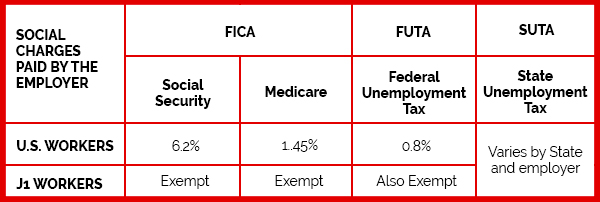
In addition to having no legal fees at the beginning of the process and no monthly healthcare coverage fees, you and your employer benefit from tax benefits under a J-1 visa. This visa is exempt from:
- Social Security tax
- Medicare tax
- Federal and State Unemployment taxes, as it is an exchange program visa, not a visa for immigration to the United States (so you will never be technically unemployed in the USA).
This will save your company about 7.79% and save you 7.11% on your taxes. Here is a table summarizing J-1 tax benefits:
Can the J-1 Visa Bring Family?
You will have the opportunity to be accompanied by your spouse and/or children. Cohabitation, or civil union, is not recognized in the United States; therefore, you need to be legally married. Your spouse and/or children will also receive a visa, a J-2 (J2), which will allow them to live with you, and your spouse will also be able to work in the U.S.A. However, you will have to prove that his or her salary is supplementary and that you do not need it to live in the U.S.
How Does the J-1 Visa Work?
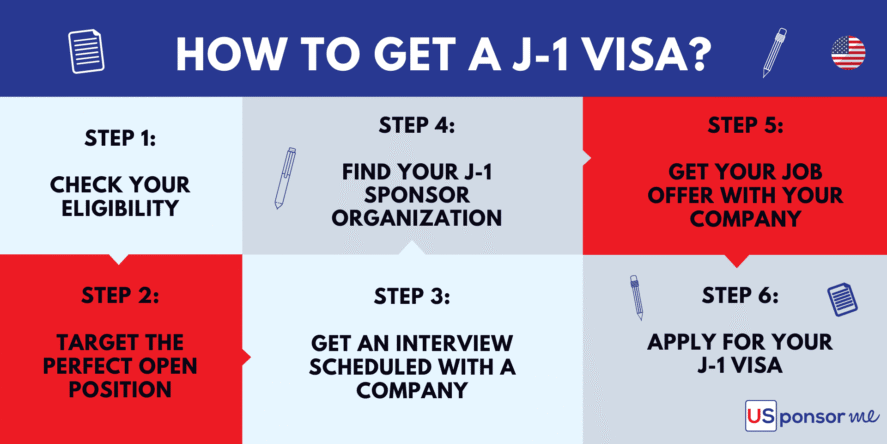
To work in the US, you will need a visa regardless of your situation. In the case of a J-1 visa, it is not your company that will have to sponsor you, but rather a J-1 sponsor organization. Please note that you cannot complete your visa application without a J-1 sponsor organization.
So, the four mandatory agents that you need for getting a J-1 visa are:
- Yourself (logical, I know);
- The company that wants to hire you;
- Your J1 Sponsor (or J1 sponsor organization);
- The US Government (specifically, the Department of State and your consulate).
You will find all the sponsor organizations for the J-1 visa here. You can contact them to obtain a sponsorship agreement before receiving a job offer (and I strongly recommend that you do so). You need an agreement from a single sponsor organization.
However, these organizations will not be able to sponsor you for the J-1 visa until you get an offer. Once you find a company that offers you a trainee program, you can apply for a visa.
There is no quota, and your application can be sent at any time throughout the year.
Do I Need a Lawyer?
Your case to apply for a J-1 visa can be one of two things: simple or complicated. Let me clarify what I mean by that: a simple visa case is one where someone has never been to the US before, either as a tourist or a student. If that situation describes you, you won’t need a lawyer and can handle your visa application on your own. Well, technically not on your own because you will receive help from your sponsor or another organization. They can assist you in submitting your application through your sponsor and embassy.
If you have already worked in the United States or participated in an exchange program, your situation will be a bit more complicated. My advice is to seek help from an immigration lawyer to ensure you are eligible and to help you prepare a solid application.
J-1 Visa Application
As it is not the host company’s responsibility to sponsor your visa, the administrative procedures on the business side are greatly simplified. You may be able to bypass hiring a lawyer if you have a very straightforward case.
And, as an applicant, you will have the possibility to take care of all the administrative procedures for your J1 visa application with your sponsor organization, without taking up the precious time of your future employer. An organization can also assist you in submitting your visa application.
Your employer will need to verify all documents, including the training program you submit.
The application process varies by program type and requires a thorough understanding of each program’s specific requirements. Indeed, if you don’t complete the proper paperwork, the foreign national’s application may be denied.
J-1 Visa Processing Time
The processing time for a J-1 Trainee visa typically ranges from 3 to 12 weeks, depending on the chosen sponsor organization, whether expedited processing is paid for, and the consulate’s availability for an interview.
J-1 Cost
The price to obtain a J-1 visa depends on the J-1 category and the program length.
For example, the J1 Trainee visa will cost between $2,000 and $3,500 for the maximum duration. Check here the J1 cost details.
Who Will Pay Your J-1 Visa Fees?
A visa is never free.
Three parties can pay the costs of the J-1 visa: you, your employer, or a government agency (if you enroll in a special program). I’m not sure whether those government agencies are the same ones that sponsor your visa (that is still to be confirmed).
To avoid the 212 rule (which forces you to return home for at least two years after your exchange visitor program), you or your employer should cover the visa fees, and not a government agency. So, if you do not want the J-1 visa 212 rule to apply to you, be very careful regarding this detail.
Depending on your financial means, you should negotiate with your employer to support these additional costs.
It is, therefore, essential to factor the cost of your visa into your expatriation budget to avoid potential shortfalls. As demand is usually higher than supply, you are likely to have to pay the visa fee.
Where can I find companies that hire people on a J-1 trainee visa?
U.S. companies come to us every week, looking to hire a J-1 trainee. We vet them and connect them with J1 trainee applicants. Here more information
Then, you will need to apply for a J1 visa through your sponsor.
To go further, find interviews and testimonials from people who have obtained a J-1 visa.
Interested in the J1 Trainee visa? Or, have you ever benefited from this visa? Share your experience in the comments below! 🙂